




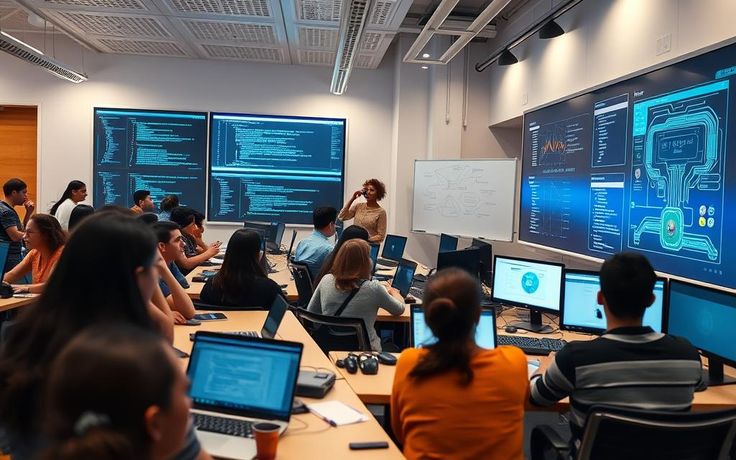
Introduction to IB Computer Science
The IB Computer Science course is an integral part of the International Baccalaureate Diploma Programme, renowned for its rigorous academic framework and global recognition.
As an offering at Thomas Keith Independent School, an online British institution, the IB Computer Science syllabus is designed to equip students with critical computational thinking skills and a profound understanding of the principles of computer science.
With the increasing significance of technology in every facet of life, the demand for computer science education continues to grow.
This course provides an in-depth exploration of computational thinking, algorithmic development, and the role of technology in both theoretical and practical contexts.
The IB Computer Science curriculum is distinguished by its unique approach to learning, focusing not just on the technical skills but also on the ethical considerations and real-world applications of computer science.
It encourages students to inquire, analyse, and evaluate, promoting a holistic educational experience.
At Thomas Keith Independent School, we prioritise a comprehensive understanding of both hardware and software components.
The curriculum includes engaging with data structures, operating systems, and the principles of computational theory—topics essential for a solid foundation in computer science.
The recognition of computer science as a cornerstone of modern education makes the IB Computer Science course an attractive choice for students aspiring to pursue careers in technology, engineering, and related fields.
An emphasis is placed on developing problem-solving skills, fostering creativity, and encouraging independent and collaborative learning.
Our specialised educators at Thomas Keith Independent School ensure that students are equipped with the necessary tools to succeed in both higher education and the ever-evolving digital world.
Through practical projects and hands-on experience, students demonstrate their understanding, thereby reinforcing their knowledge and skills.
The IB Computer Science course is structured to meet the demands of both the Higher Level (HL) and Standard Level (SL) students, accommodating varying degrees of complexity and depth.
By embedding current SEO best practices in educational content, we strive to engage students, parents, and educators while maintaining our commitment to factual accuracy and academic excellence.
In summary, the introduction of IB Computer Science to the offerings at Thomas Keith Independent School represents a commitment to providing a robust and future-oriented education for our students.
This course not only prepares students for further education and professional pursuits but also encourages them to be informed and responsible digital citizens.
Understanding the IB Diploma Programme
Understanding the International Baccalaureate (IB) Diploma Programme is crucial for students aiming to excel in rigorous and comprehensive courses such as IB Computer Science.
The IB Diploma, recognised globally, offers a versatile and diverse curriculum that prepares students for higher education and beyond.
At Thomas Keith Independent School, we provide analytical insights into the structure and objectives of the IB Diploma Programme, helping students navigate their academic journey effectively.
The IB Diploma Programme consists of six subject groups, with computer science falling under Group 5, Mathematics and Computer Science, highlighting its integration with analytical and technical disciplines.
Each student is required to choose courses across these groups, ensuring a well-rounded education.
IB Computer Science teaches problem-solving, computational thinking, and programming skills, which are essential in today’s technology-driven world.
Students in the programme also undertake the core components, which include Theory of Knowledge (TOK), the Extended Essay (EE), and Creative, Activity, Service (CAS). These core elements encourage students to develop a holistic educational outlook, critical thinking, and a balanced approach to learning.
Enrolling in the IB Diploma Programme at Thomas Keith Independent School means participating in a curriculum designed to foster intellectual growth through inquiry and research.
Our students experience a unique academic path that not only aims to achieve success in subjects like IB Computer Science but also to apply their knowledge in practical and meaningful ways in real-world scenarios.

Course Structure and Content
The IB Computer Science course is meticulously designed to provide students with a comprehensive understanding of computational principles and their application in real-world contexts.
It is structured to balance theoretical knowledge with practical skills, ensuring that learners are well-equipped for both further education and future employment within the rapidly evolving field of technology.
At Thomas Keith Independent School, we are committed to delivering an engaging online curriculum that aligns with the rigour of the IB Computer Science syllabus.
Core Content
The IB Computer Science course is divided into several core topics that form the foundational knowledge required in the field.
These topics include System Fundamentals, which covers the basics of computer organisation, architecture, networks, and system design.
Another critical area is Computer Organisation, where students learn about hardware and software components, their functions, and how they interact within a system.
We also delve into Computational Thinking, Problem-Solving and Programming, focusing on developing student skills in algorithmic thinking and coding.
These foundations are vital in understanding and developing efficient programs and solutions in computing.
Higher Level Extension
For those pursuing the Higher Level (HL) course, additional topics are included to deepen understanding and challenge students further.
This includes an extended exploration of Abstract Data Structures, which is crucial for building complex and efficient software.
Students at HL study Resource Management, which focuses on system efficiency and optimising resource usage in computing environments.
The additional content equips HL students with a more profound knowledge of the technical and theoretical aspects of computer science, enhancing their problem-solving capabilities.
Practical Application
Practical work is a significant element of the IB Computer Science curriculum.
Students are required to undertake an Internal Assessment (IA), which involves developing a software solution to a problem of their choice.
This project enables students to apply the theoretical knowledge they have acquired in a practical context, providing a holistic understanding of software development processes from conception to execution.
At Thomas Keith Independent School, our experienced educators guide students through every stage of their IA, ensuring they gain valuable insights and skills.
Optional Topics
In addition to the mandatory core and HL content, the curriculum offers Optional Topics that allow students to explore areas of personal interest or those aligned with their career aspirations.
These topics can include Object-Oriented Programming, Web Science, and Artificial Intelligence, providing a tailored educational experience in IB Computer Science.
Optional Topics encourage students to engage deeply with specific areas of computer science, enhancing their learning journey and preparing them for specialised future studies or careers.
Conclusion
In summary, the IB Computer Science course provides a robust framework for students to develop a strong grounding in computer science principles and their practical application.
With a balance of core content, higher-level exploration, practical projects, and optional topics, it offers a comprehensive and engaging curriculum.
At Thomas Keith Independent School, we strive to deliver this challenging yet rewarding syllabus through our expertly crafted online platform, preparing students for success in the technologically-driven world.
Resources for Teaching IB Computer Science
Teaching IB Computer Science requires a robust set of resources to ensure students gain a comprehensive understanding of the subject.
At Thomas Keith Independent School, we understand the importance of providing educators with the necessary tools to effectively teach the IB Computer Science syllabus.
Resources are fundamental to covering the extensive curriculum, which encompasses both theoretical concepts and practical applications in computer science.
The integration of digital resources has become increasingly important in adapting to the evolving educational landscape.
Textbooks remain a staple, offering foundational knowledge necessary for both Higher Level (HL) and Standard Level (SL) students.
Publications like “Computer Science for the IB Diploma” provide detailed explanations of course topics, ensuring students gain a clear understanding of core principles.
Online platforms have revolutionised IB Computer Science teaching, offering interactive elements that engage students beyond traditional lectures.
Websites such as the IB CompSci Hub offer countless resources tailored to the IB framework, including sample assessments, lesson plans, and subject-specific tutorials.
These resources help teachers structure their lessons in line with the latest IB standards.
Professional development programmes for teachers also play a crucial role.
Workshops and online courses keep educators up-to-date with the latest advancements in computer science and teaching methodologies.
Organisations often offer specialised training sessions focused on implementing the IB Computer Science curriculum effectively.
Collaborative tools like forums and social media groups provide platforms for educators to share their experiences and resources.
By engaging with a community of fellow IB Computer Science educators, teachers can exchange insights and innovative practice ideas that enrich the learning experience.
Lastly, incorporating real-world applications and case studies into the curriculum helps bridge the gap between theory and practice.
This approach not only bolsters students’ problem-solving skills but also enhances their understanding of how computer science principles apply to real-life scenarios.
In summary, a diverse array of resources enhances the teaching and learning of IB Computer Science by providing both depth and breadth of content.
By utilising these resources, educators at Thomas Keith Independent School ensure that their students are well-prepared to excel in their IB Computer Science examinations and future endeavours.
Higher Level vs. Standard Level
In IB Computer Science, understanding the distinction between Higher Level (HL) and Standard Level (SL) coursework is crucial for both students and educators at Thomas Keith Independent School.
Each level caters to different academic needs and aspirations.
The IB Computer Science curriculum is tailored to offer comprehensive knowledge, but the depth and complexity differ significantly between HL and SL.
Higher Level (HL) in IB Computer Science is designed for students who are deeply interested in the subject and potentially planning a future career in technology or computer science.
This level provides a thorough exploration of complex algorithms, data structures, and problem-solving techniques.
HL students are required to undertake an additional option topic and deep dive into the theory of computation, which is not covered at SL.
The HL course demands a considerable amount of independent research and project work, which develops critical thinking and applied skills.
On the other hand, Standard Level (SL) offers a broad overview of computer science concepts, allowing students to gain foundational knowledge in IB Computer Science without the intensity of HL.
SL covers the core topics, including system fundamentals, computer organisation, networks, and programming.
While the SL course is less in-depth, it still equips students with essential skills and understanding to tackle technological challenges.
The assessment structure also varies between HL and SL.
HL students must complete three external examinations, an internal assessment, and a complex programming project.
SL students, however, are assessed through two external examinations and a simpler version of the internal assessment project.
Choosing between HL and SL in IB Computer Science should be based on the student’s interest level, academic goals, and capacity to handle rigorous coursework.
At Thomas Keith Independent School, guidance is provided to ensure students make informed decisions.
Understanding the differences between HL and SL is pivotal in aligning educational paths with future aspirations in the field of computer science.
Key Topics in IB Computer Science
In the IB Computer Science curriculum, key topics are designed to equip students with a comprehensive understanding of both theoretical and practical aspects of computing.
The IB Computer Science course at Thomas Keith Independent School places strong emphasis on these topics to ensure students develop essential computational thinking skills and are fully prepared for further education and careers in computing.
One of the fundamental areas of study in the IB Computer Science syllabus is system fundamentals.
This topic covers essential concepts such as computer organisation, hardware and software, and the social and ethical significance of computing technology.
Students learn about the architecture of computer systems, input and output devices, and the nuanced relationship between software and hardware components.
Another critical topic is computational thinking, problem-solving, and programming.
This aspect of the IB Computer Science course involves understanding algorithms, data structures, and computational models.
Students engage in writing code, debugging, and developing efficient algorithms to solve complex problems.
Programming languages such as Java or Python are typically used to introduce students to practical coding tasks that solidify their theoretical knowledge.
Data representation is also a significant topic in the IB Computer Science course.
Students explore how various types of data, including numbers, text, images, and sound, are represented in a digital format.
This includes learning about binary systems, hexadecimal numbers, and ASCII code, providing students with a deeper understanding of how data is manipulated and stored in computer systems.
A vital area that reflects modern technological advancements is networks and communication.
The curriculum includes the study of network types, protocols, and security measures.
Students develop an understanding of how networks function, the importance of internet protocols, and strategies for safeguarding data in an interconnected world.
The future-focused topic of artificial intelligence and machine learning is gaining traction within the IB Computer Science syllabus.
Students are introduced to concepts such as neural networks, machine learning algorithms, and the ethical considerations of AI technologies.
This equips students with a foundational understanding of how intelligent systems work and their potential societal impacts.
Thomas Keith Independent School ensures that these key topics in IB Computer Science are not only covered thoroughly but are also woven into an engaging learning experience.
By utilising both primary resources and supplementary materials, students gain a well-rounded education that meets and exceeds the IB standards.
In conclusion, the key topics in IB Computer Science are integral to providing students with a robust framework of computing knowledge.
Each topic is carefully chosen to build upon previous knowledge, encouraging academic growth and fostering a keen interest in the field of computer science.
Assessment and Evaluation
In the IB Computer Science course, assessment and evaluation are critical components that ensure students achieve a comprehensive understanding of both theoretical and practical elements of the discipline.
This structured assessment approach is meticulously designed to cater to the diverse cognitive and analytical skills necessary for success in computer science.
The Internal Assessment (IA) is a crucial facet of the IB Computer Science evaluation.
Students are required to undertake a project that merges their theoretical knowledge with practical application.
This project allows them to demonstrate skills such as problem-solving, critical thinking, and programming.
It accounts for a significant portion of the final grade, making it imperative for students to invest effort and creativity.
External assessments are divided into three separate examinations for the Higher Level and two for the Standard Level.
These exams test understanding across various topics, including computational thinking, system fundamentals, and databases.
Exam papers are designed to challenge students’ grasp of both the theory and application of computer science principles, cementing their understanding of core topics.
Criteria-based marking is another key element of IB Computer Science assessments.
Students are evaluated against specific benchmarks, promoting transparency and clear expectations.
This system allows for objective grading and provides students with clear feedback on areas needing improvement.
Furthermore, the IB Computer Science course emphasises the importance of reflecting on the ethical and social implications of technology.
This holistic approach ensures that students not only develop technical skills but also a sense of responsibility in their future ICT endeavours.
At Thomas Keith Independent School, we encourage our students to engage with the assessment process as a learning opportunity.
Our supportive academic environment aims to guide them through each step of the IB Computer Science assessments.
By focusing on thorough preparation and understanding the evaluation criteria, students are empowered to excel in both their internal and external assessments, laying a solid foundation for future endeavours in the field of computer science.
Tips for Success in IB Computer Science
Achieving success in IB Computer Science requires a blend of technical skills, a strong understanding of theoretical concepts, and effective study strategies.
As part of Thomas Keith Independent School, we understand the importance of providing students with the right tools and guidance to excel in this challenging subject.
Below are some key tips to help students succeed in their IB Computer Science course.
First and foremost, mastering the fundamentals of programming is essential.
Whether you are taking the Higher Level or Standard Level course, programming is a core component of IB Computer Science.
Dedicate time to learn and practice coding in the required programming language, and utilise online resources and coding platforms to strengthen your skills.
Time management is another crucial factor.
The IB Computer Science curriculum is rigorous, with a significant amount of content to cover.
Develop a study schedule that allocates regular time for review sessions, practice exercises, and coursework.
Staying organised will help you manage the workload more effectively and reduce stress.
An in-depth grasp of key concepts, such as algorithms, data structures, and computational thinking, is also vital.
These topics form the backbone of the IB Computer Science curriculum and often intersect with other areas of the course.
Engage in active learning by discussing these concepts with peers or attempting to teach back what you’ve learned.
Another valuable strategy is to utilise past examination papers and IB-specific resources.
Exam patterns often repeat, and practising with previous papers can provide valuable insights into the types of questions you may encounter.
Thomas Keith Independent School provides access to curated resources that align with the IB syllabus.
Finally, seek feedback regularly from your teachers.
Constructive feedback can highlight areas of improvement and provide a clearer understanding of topics you may find challenging.
Our online platform facilitates communication between students and educators, ensuring personalised support is always available.
By focusing on these strategies, students at Thomas Keith Independent School can enhance their performance and achieve success in IB Computer Science.
Remember, consistency and dedication are your best allies in mastering this subject.
Conclusion
The IB Computer Science programme at Thomas Keith Independent School offers a comprehensive and intellectually stimulating curriculum tailored to equip students with essential computing skills and knowledge.
By focusing on fundamental and advanced topics in the field, students are well-prepared for further studies and professional endeavours.
The IB Computer Science course emphasizes not only theoretical understanding but also practical applications, ensuring a well-rounded education.
This rigorous approach aids in fostering critical thinking and problem-solving skills, which are vital in today’s technology-driven world.
As students progress through the IB Computer Science curriculum, the structured learning experience supports their academic growth and readiness for future challenges.
With the wealth of resources available, including experienced instructors and cutting-edge materials, Thomas Keith Independent School ensures that students are fully supported in their journey through IB Computer Science.
The combination of structured coursework and dedicated guidance paves the way for success in both academic and professional pursuits, helping students to excel in a rapidly evolving field.
