





Introduction to Secondary School Classrooms in the UK
The secondary school classroom in the UK plays a critical role in a student’s educational journey, providing an environment that supports both academic and personal growth.
In the UK, secondary education typically spans five to seven years, serving students aged 11 to 18, segmented into Key Stages 3, 4, and sometimes 5.
Each stage presents its own set of curricular demands, requiring classroom spaces to be adaptable and equipped to cater to a diverse range of subjects.
This adaptability is crucial for properly supporting the varied curriculum and activities in a secondary school classroom in the UK.
Classrooms in secondary schools are uniquely designed to facilitate a broad spectrum of subjects, including sciences, humanities, and arts, often requiring specialised equipment and resources.
Daylight and electric lighting play a significant role in these environments, influencing both academic performance and well-being.
Lighting quality can impact visual comfort and concentration, which are crucial factors in enhancing educational outcomes.
The integration of appropriate illumination is pivotal in ensuring that secondary school classrooms in the UK maintain an atmosphere conducive to learning.
With technology becoming increasingly integrated into education, classrooms are now equipped with digital devices and interactive systems, promoting engagement and broadening the scope for innovative teaching methods.
The UK’s educational system is moving towards creating more interactive and inclusive learning spaces by incorporating modern technology and sustainable design strategies.
Sustainable initiatives, such as the effective use of natural light and energy-efficient electric lighting, are being prioritised.
These initiatives aim to enhance the health, engagement, and performance of students within the classroom setting.
Understanding the intricate dynamics at play in a secondary school classroom in the UK underscores the importance of thoughtful design and resource allocation.
It ensures that students and educators are provided with a supportive, inspiring, and functional space for educational excellence.
Structure of the UK Secondary School System
The organisation of the UK secondary school system is integral to understanding how a secondary school classroom in the UK is structured and functions daily.
Typically, secondary education in the UK begins at age 11 and runs through to age 16, after which students may continue to Sixth Form.
Secondary schools are generally divided into two key stages: Key Stage 3 (Years 7-9) and Key Stage 4 (Years 10-11).
During Key Stage 3, pupils start to experience a broader curriculum, often involving multiple subject specialists, which marks a significant shift from the primary education approach, where one teacher may cover many subjects.
Key Stage 4 is particularly noteworthy for the introduction of General Certificate of Secondary Education (GCSE) assessments.
These examinations are crucial as they determine students’ academic strengths and potential career paths.
In a typical secondary school classroom in the UK, subjects such as Mathematics, English, and Science are core, but pupils also select additional courses, which can include humanities, arts, technology, and languages.
Despite differences in curriculum specifics across various educational authorities, the focus remains on providing a comprehensive education that prepares students robustly for the next stage, whether that be further education or entering the workforce.
Class schedules in UK secondary schools often follow a pattern of blocks or periods, with pupils moving between different classrooms and subject-specific teachers throughout the day.
This structure not only allows for specialised teaching but also simulates the kind of independent responsibility that students will face in higher education settings.
On top of academic subjects, numerous schools offer extracurricular activities, which are crucial in developing students’ social skills, physical health, and even academic success indirectly.
The secondary school classroom in the UK, equipped with both daylight and electric lighting as per the educational standards, is designed to facilitate an optimal learning environment.
Through strategic exposure to natural daylight and regulated electric lighting, schools aim to enhance student concentration and minimise potential distractions, adhering to educational studies and research on the impact of classroom environments on student performance.
Overall, the structure of the UK secondary school system is designed to offer a well-rounded education, adapting to both academic and developmental needs.
At Thomas Keith Independent School, we strive to provide a supportive environment that meets and exceeds these educational standards, helping our students to thrive in every secondary school classroom in the UK.

Daylight and Electric Lighting in Classrooms
Understanding the impact of lighting in a secondary school classroom in the UK is crucial for optimising both student performance and well-being.
In any classroom, lighting influences visual comfort, concentration, and the overall learning environment.
Daylight is the most desirable form of lighting in a secondary school classroom in the UK because of its positive effects on mood and alertness.
The incorporation of windows and skylights in classroom architecture is a primary strategy to maximise natural light exposure.
However, the UK’s often overcast weather necessitates the supplemental use of electric lighting to ensure consistent illumination throughout the school day.
Electric lighting systems in a classroom in a secondary school in the UK must emulate the quality of natural daylight as closely as possible.
Innovations in lighting technology, such as LED lights, have enabled significant improvements in both energy efficiency and lighting quality.
LEDs, with their adjustable brightness and reduced flicker, make them an ideal choice for the secondary school classroom UK setting.
Appropriate lighting can also help in reducing the prevalence of visual discomfort and myopia, which are common issues among school children.
The flicker-free and spectrally stable characteristics of modern electric lighting reduce eye strain, supporting a healthier learning environment.
Implementing lighting solutions that modulate based on the time of day can align with students’ circadian rhythms, enhancing their focus and energy levels.
Moreover, lighting assessments should account for the distinct needs of each classroom, factoring in room size, window placement, and typical activities conducted within.
Beyond the technical specifications, the visual aesthetics of lighting systems can also have psychological impacts on students.
A well-illuminated classroom has been linked to increased student engagement and overall academic achievement.
Therefore, the strategic design and implementation of daylight and electric lighting in a secondary school classroom in the UK can be a potent tool for improving educational outcomes.
Equipping secondary school classrooms with optimal lighting should be a priority for educational institutions aiming to foster cognitive and personal development.
Impact of Lighting on Student Health and Performance
The type and quality of lighting in a secondary school classroom in the UK can significantly impact student health and performance.
Lighting in classrooms is not just about visibility; it plays a crucial role in setting the mood and facilitating effective learning.
Research indicates that proper lighting can enhance student concentration and mental well-being, while poor lighting conditions can lead to health issues and reduced academic performance.
In the typical UK secondary school classroom, emphasis is often placed on a blend of natural daylight and electric lighting to optimise the learning environment.
Natural daylight is considered beneficial for reducing stress and improving mood among students.
Exposure to daylight helps regulate the circadian rhythm, which is instrumental in maintaining alertness and energy levels during the academic day.
This natural exposure is particularly important in the morning classes, where it can help mitigate sleepiness and improve cognitive performance.
Electric lighting, on the other hand, complements daylight by ensuring consistent illuminance levels, especially during overcast days or in classrooms that receive insufficient natural light.
The spectral quality of electric lighting is critical; therefore, lights with a cooler temperature are often preferred as they mimic natural daylight more closely.
Inadequate lighting, including flicker from electric lights, can lead to visual discomfort and even issues such as eye strain and headaches among students.
Continuous exposure to such conditions might contribute to long-term visual problems, including the development of myopia in children.
An interesting observation in classrooms in secondary schools UK is the consideration of lighting quality during renovation and school building designs.
Schools aim to create an environment that not only supports academic excellence but also promotes overall student health.
As such, assessments are regularly conducted to measure lighting performance against health and visual comfort standards.
To further optimise lighting in secondary school classrooms, some schools are adopting dynamic lighting systems.
These systems adjust the intensity and colour temperature of electric lighting throughout the day to align with natural daylight cycles.
In conclusion, lighting conditions within secondary school classrooms in the UK directly influence both student health and academic outcomes.
Ensuring that lighting is both suitable and sufficient is an essential factor in creating an effective and healthy educational setting.
Schools like Thomas Keith Independent School recognise the importance of these factors and strive to implement the best practices in their learning environments.
Typical Classroom Environment and Layout
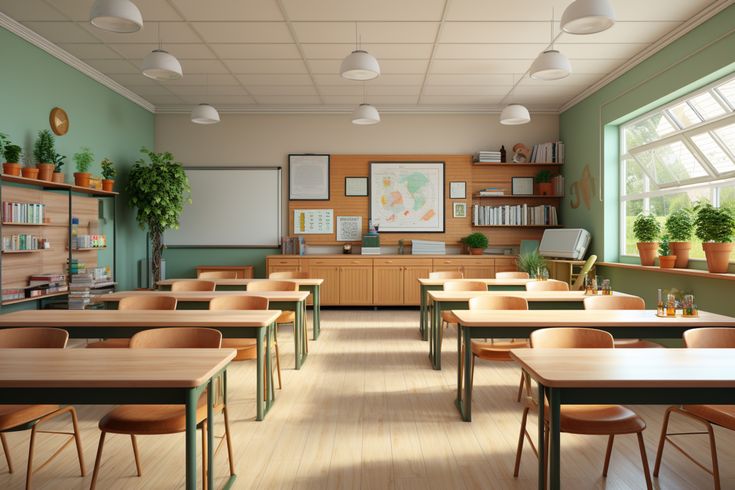
In the secondary school classroom in the UK, the environment and layout play crucial roles in shaping the educational experience and enhancing student learning outcomes.
A well-designed classroom in a secondary school in the UK typically combines both functionality and comfort to foster a conducive learning atmosphere.
Modern secondary school classrooms often adopt flexible layouts that can be easily rearranged to support various teaching methods, whether it be lectures, group work, or interactive activities.
Desks and chairs in these classrooms are usually modular, allowing educators to create configurations that best suit the lesson’s objective.
Incorporating technology, such as interactive whiteboards and digital projectors, is also prevalent, providing dynamic teaching tools that cater to diverse learning styles.
Moreover, classrooms in secondary schools are designed to optimise natural light intake through large windows, which are found to positively affect student concentration and mood.
The inclusion of electric lighting systems equipped with dimmable and energy-efficient fixtures ensures consistent lighting conditions, especially during the darker weather typical in the UK.
Attention to acoustics is another vital element in designing a secondary school classroom in the UK, as a well-insulated environment reduces external noise, helping students maintain focus.
Adequate storage solutions, such as built-in cabinets and shelving, are integrated to keep resources organised, thereby minimising clutter and distractions.
Temperature control systems, including heating and ventilation, are maintained to ensure a comfortable environment throughout the school year, which is critical for maintaining student productivity and well-being.
By considering these elements, the typical UK secondary school classroom is designed not only to meet educational needs but also to enhance the overall student experience and optimise learning potential.
Technological Integration in Classrooms
In a typical secondary school classroom in the UK, the integration of technology plays a crucial role in enhancing educational delivery and student engagement.
The presence of advanced technologies in classrooms not only facilitates diverse methods of instruction but also promotes interactive learning experiences.
In the modern classroom in the UK’s secondary schools, digital devices such as tablets and laptops have become essential tools.
These technologies enable students to access a wealth of information instantly, fostering a more self-directed learning environment.
Moreover, the use of interactive whiteboards has redefined traditional teaching methods.
Interactive whiteboards allow teachers to present dynamic visual content, making complex subjects more comprehensible and engaging for students.
This aligns with the educational objectives of many institutions, including Thomas Keith Independent School, where technology integration is a key component of our pedagogical strategy.
Furthermore, online platforms and learning management systems are integral to secondary school classrooms in the UK.
These platforms enable the seamless administration of assignments, assessments, and feedback, streamlining the educational process for both teachers and students.
The utilisation of cloud-based tools also promotes collaboration among students, giving them the ability to work together on projects regardless of their physical location.
Significantly, the incorporation of technology addresses various learning styles and needs, accommodating children who may benefit from visual, auditory, or kinetic learning methodologies.
This makes the technology-rich environment of a secondary school classroom in the UK an inclusive space for all students.
While technology undoubtedly enriches the educational experience, it is vital to continually assess its impact on student performance and adapt to emerging technological trends.
By prioritising effective technological integration, Thomas Keith Independent School aims to prepare students for future challenges and opportunities in an ever-evolving digital landscape.
Challenges and Considerations in Classroom Design
Designing a secondary school classroom in the UK involves addressing numerous challenges and considerations to create an optimal learning environment.
A key consideration is the balance between daylight and electric lighting, which is crucial for maintaining students’ health and performance.
Classroom lighting must be designed to reduce glare and optimise visual comfort, which requires precise assessment and measurement of both daylight exposure and electric light modulation.
Another significant challenge is accommodating modern technology while maintaining flexibility in classroom layouts.
As different subjects may require various setups, classrooms must be adaptable to support everything from digital learning tools to traditional desk arrangements.
The inclusion of technology in classroom design should also consider the need for sufficient power outlets and wireless connectivity without cluttering the space or diminishing focus.
Moreover, acoustic considerations come into play, as classrooms should minimise noise levels to support concentration.
Sound-absorbing materials can help in achieving a quieter environment conducive to learning.
The height and arrangement of furniture, such as desks and chairs, must also be tailored to student comfort, accounting for various heights and ensuring ergonomic suitability.
Finally, an effective secondary school classroom design should foster an inclusive environment, addressing accessibility needs for all students, including those with disabilities or requiring special educational accommodations.
Each of these considerations plays a critical role in creating secondary school classrooms that not only facilitate education but also enhance the overall well-being and performance of students.
For institutions like Thomas Keith Independent School, ensuring that these design elements are well-integrated is fundamental to providing an engaging and effective learning experience.
Conclusion and Future Trends
In examining the secondary school classroom in the UK, it is evident that the dynamic nature of educational environments continues to evolve.
This evolution is influenced by technological advancements, changing pedagogical practices, and increasing awareness of factors such as well-being and inclusivity within the secondary school UK setting.
Nowadays, one can hardly underestimate the impact of a well-designed secondary school classroom on student engagement and learning outcomes.
Future trends indicate a further integration of technology within the secondary school classroom in the UK, aimed at enhancing interactive learning and making education more accessible.
Adaptive learning technologies, augmented reality, and virtual reality will likely see increased usage, not only transforming how lessons are delivered but also how subjects are explored.
Such technological advances promise to make learning more personalised and immersive within the classroom in secondary schools UK.
Additionally, there is a growing emphasis on designing classrooms that promote physical and mental health through optimal lighting, ergonomic furniture, and spaces that encourage collaboration and creativity.
As schools like Thomas Keith Independent School continue to prioritise these aspects, the focus remains on constructing environments that support diverse learning needs, ensuring that every classroom in secondary schools UK is a place of equal opportunity and inspiration.
Ultimately, staying ahead of such trends requires ongoing research and innovation, paving the way for a future where the secondary school classroom in the UK not only meets educational standards but also adapts to the ever-evolving landscape of global education.
By embracing these developments, we are poised to offer students not just an education but a transformative learning experience that prepares them for the challenges and opportunities of tomorrow.
